The subsoil of Hervey Bay is dominated by Quaternary coastal deposits — fine to medium sands with variable silt content, interbedded with clayey layers from the Mary River floodplain. Groundwater sits shallow, often between 1.5 m and 3.0 m depth, which directly affects the effective stress conditions during loading. To obtain reliable strength parameters for foundation design in this environment, we run consolidated-undrained (CU) and unconsolidated-undrained (UU) triaxial tests on undisturbed samples recovered from boreholes. The data feeds into bearing capacity checks and slope stability models, particularly where the soil transitions from loose sand to stiff clay at depth. Before sampling, we coordinate with the drilling crew to ensure sample integrity, using thin-wall tube samplers as required by AS 1726. The results are cross-checked against field vane shear tests performed in the softer clay layers to validate the undrained shear strength profile.
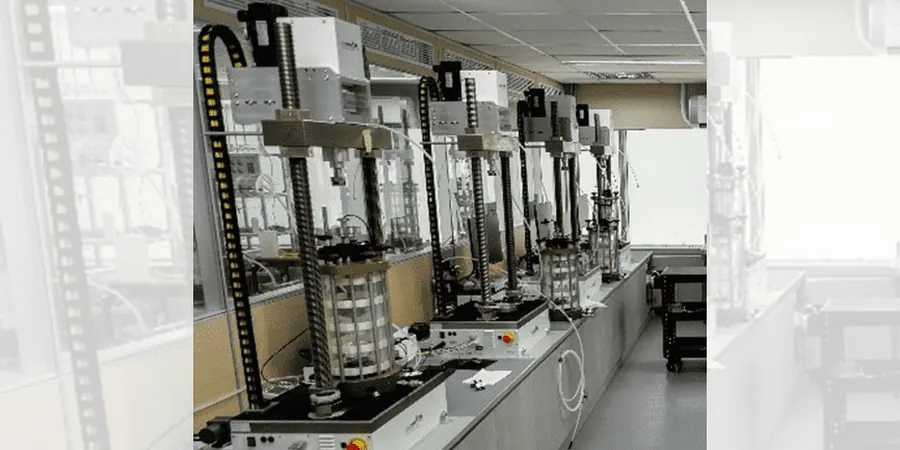
In Hervey Bay's saturated sands, the effective friction angle from triaxial CU tests typically ranges from 30° to 36° — critical for foundation design near the foreshore.
Service characteristics in Hervey Bay
- Specimen trimming and saturation under back pressure
- Consolidation under isotropic stress to field effective stress
- Shearing at constant strain rate with pore pressure measurement
Critical ground factors in Hervey Bay
Hervey Bay's urban expansion since the 1990s has pushed development into low-lying coastal flats and reclaimed areas east of the city centre. These zones are underlain by loose to medium-dense sands with high liquefaction susceptibility during seismic events, even though the region is not classified as high-hazard. The main geotechnical risk is not collapse but excessive differential settlement under cyclic loading, especially for two-storey residential slabs on shallow footings. Without a triaxial test that captures the undrained cyclic response, the foundation design may underestimate post-construction settlement by 30 % or more. We flag this risk in every report for projects within 2 km of the coastline, recommending CU tests with cyclic loading stages when the building exceeds two levels.
Our services
We offer two triaxial testing packages tailored to Hervey Bay's soil conditions, from preliminary design to detailed verification.
Standard UU / CU Triaxial Suite
Three to six specimens tested at confining pressures matching the estimated overburden. Includes saturation, consolidation, shearing, and a full report with Mohr-Coulomb envelope. Suitable for residential slabs and light commercial pads on sand or silty sand.
Advanced CD and Cyclic Triaxial
Drained tests at slow strain rate for long-term stability analysis, plus cyclic loading stages for liquefaction assessment. Recommended for multi-storey buildings, bridge abutments, and retaining walls near the Hervey Bay Esplanade.
Frequently asked questions
What is the difference between UU, CU, and CD triaxial tests, and which one does my Hervey Bay project need?
UU (unconsolidated-undrained) tests give the undrained shear strength for short-term loading, ideal for rapid construction on clay layers. CU (consolidated-undrained) tests measure effective strength parameters after full consolidation — relevant for sandy soils in Hervey Bay where drainage occurs during loading. CD (consolidated-drained) tests simulate fully drained conditions for long-term stability analyses. For most residential projects on the coastal sands, CU at three confining pressures provides the necessary c' and φ' values.
How much does a triaxial test cost in Hervey Bay?
The typical cost for a standard triaxial test suite (three UU or CU specimens) ranges from AU$2,640 to AU$3,870 depending on the number of confining stages and whether cyclic loading is included. The price covers specimen preparation, saturation, shearing, and a detailed report with stress-strain curves and Mohr circles. For a precise quote, contact us with the number of specimens and test type required.
Can triaxial test results be used for liquefaction assessment in Hervey Bay's sandy soils?
Yes, but only if the test includes cyclic loading stages. A standard monotonic CU test gives the static strength, not the cyclic resistance. We recommend cyclic triaxial tests (AS 1289) for projects in Hervey Bay's low-lying areas where the water table is high. The cyclic stress ratio (CSR) from the test can be compared with the seismic demand from AS/NZS 1170.4 to evaluate liquefaction triggering.
How long does it take to get triaxial test results from your Hervey Bay laboratory?
Standard UU or CU tests are completed within 5 to 7 business days from sample receipt. CD tests take longer — typically 10 to 14 days — because of the slow strain rate required to maintain drained conditions. If you need expedited results for a critical deadline, we can prioritise the test sequence and deliver preliminary strength parameters within 3 days for UU tests.