Hervey Bay sits on coastal sands and estuarine clays that rarely achieve more than 90% of their potential density without mechanical compaction. The region receives around 1,200 mm of rain annually, so achieving the right moisture-density relationship is critical before any fill or pavement layer is placed. A Standard Proctor test (AS 1289.5.1.1) or Modified Proctor (AS 1289.5.2.1) tells the construction team exactly how much water and energy the soil needs to reach its target density. In our experience, even well-graded sands from the Fraser Island deposits can lose 8% of their bearing capacity if compacted 2% dry of optimum. That margin matters when you are building a new subdivision near Pialba or upgrading the Bruce Highway approaches. We combine Proctor results with a plate load test to verify field compaction on critical fills, and with CBR testing for pavement design. The goal is simple: quantify the compaction curve before the roller starts.
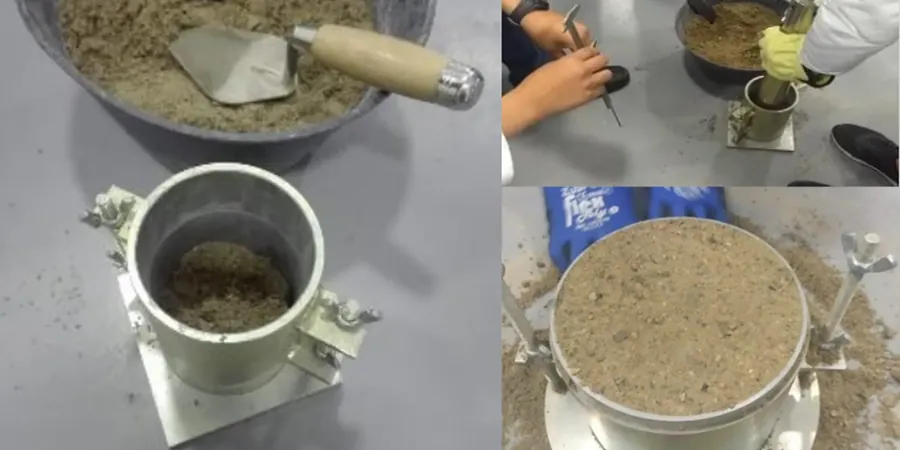
Even well-graded sands from the Fraser Island deposits can lose 8% of bearing capacity if compacted 2% dry of optimum.
Service characteristics in Hervey Bay
- Maximum dry density (MDD) in t/m³
- Optimum moisture content (OMC) in %
- Degree of saturation at OMC
- Void ratio at MDD
- Dry density ratio for field compliance
Critical ground factors in Hervey Bay
Hervey Bay's urban growth accelerated in the 1990s with canal estates and coastal subdivisions built on soft Holocene deposits. Many of those early fills were placed without proper compaction testing. The result? Differential settlement in residential slabs and premature rutting in local roads. We still see subdivision lots where the fill achieved only 88% of Standard Proctor because the moisture was too high after a wet season. The risk is that a contractor assumes his roller will fix everything. It won't. Without a Proctor curve, you are guessing the target density. And when the water table sits 1.5 m below surface in Urangan, a wet fill can take weeks to dry back. That delay costs money and invites erosion. A proper compaction control program avoids that entirely.
Our services
Beyond the Proctor test itself, we offer a full suite of compaction-related services tailored to Hervey Bay's soil conditions.
Field Density Verification (Nuclear Gauge)
On-site testing using a calibrated nuclear densometer to measure wet density, dry density and moisture content. Results are compared against the Proctor curve to calculate the compaction ratio. We cover all Hervey Bay suburbs including Scarness, Torquay and Point Vernon.
CBR Testing for Pavement Design
California Bearing Ratio tests on remoulded samples compacted at Proctor optimum. The soaked CBR value is used by civil engineers to design flexible pavements for roads, car parks and industrial hardstands in the region.
Moisture-Density Relationship Reports
Full laboratory report including the compaction curve, MDD, OMC and saturation line. We also provide a field compaction specification sheet so the project team knows the target dry density ratio (usually 95% to 98% of MDD) for each fill layer.
Frequently asked questions
What is the difference between Standard and Modified Proctor test?
The Modified Proctor uses a heavier rammer (4.54 kg vs 2.5 kg) dropped from a greater height (457 mm vs 305 mm), delivering about 4.5 times more compaction energy per volume. It simulates heavy roller compaction and is specified for high-load pavements and deep fills. The Standard Proctor suits lighter traffic and residential slabs.
How many soil samples are needed for a Proctor test in Hervey Bay?
We typically require 25 to 30 kg of representative bulk sample per test. For layered fills (sand, clay, gravel), each material type needs its own Proctor curve. A single test covers one material. If the fill varies across the site, we recommend one test per 500 m³ of placed fill.
How much does a Proctor test cost in Hervey Bay?
The typical cost ranges between AU$160 and AU$290 per test, depending on whether it is Standard or Modified and whether you need same-day or standard turnaround. Volume discounts apply for multiple samples. The price includes the full compaction curve report.
Can I use the Proctor result from a nearby site for my project?
Not reliably. Hervey Bay's soils vary within 200 metres — clean dune sand near the beach, organic clays in the canal estates, and stiff clay on the ridge. Each material has a unique compaction curve. Using a borrowed result can lead to under-compaction or over-compaction. We always recommend a site-specific test.