A common mistake we see in Hervey Bay is builders assuming the sandy coastal soils won't settle. That assumption costs time and money. The sands here are loose. They hide pockets of soft estuarine clay. Without an oedometer consolidation test, you cannot predict how much a slab will sink. We run this test on undisturbed samples before any foundation design begins. It gives us the compression index and pre-consolidation pressure. That data directly informs the footing size. For light commercial projects we often pair this with a placa de carga to compare lab settlement against field behaviour. The difference can be significant. Get the numbers right before you pour concrete.
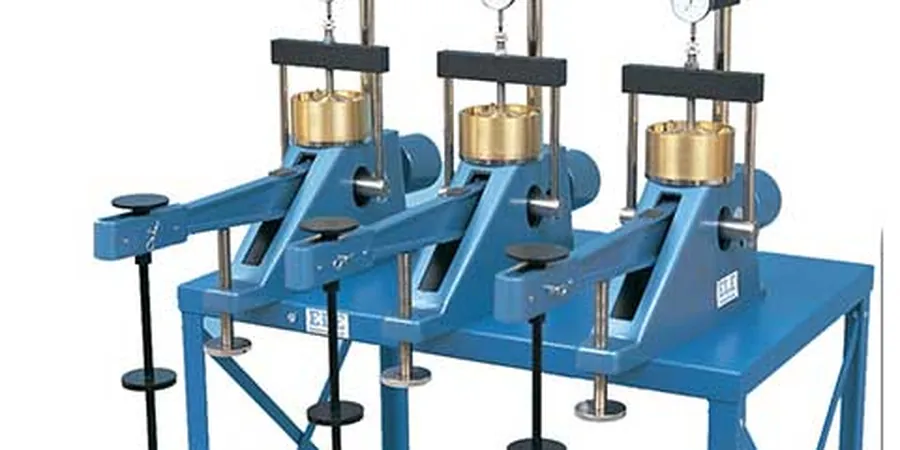
We measure the compression index and pre-consolidation pressure directly from undisturbed samples. No guessing. No textbook assumptions.
Service characteristics in Hervey Bay
Critical ground factors in Hervey Bay
A three-storey hotel near the Esplanade was designed on shallow footings. The geotechnical report skipped the oedometer consolidation test. The owner noticed cracks in the masonry after six months. We were called in to investigate. The soil was a soft silty clay with a compression index of 0.38. Total settlement exceeded 80 mm. Half of that was consolidation of the clay layer. The fix required underpinning with driven piles. That cost three times what the oedometer test would have. Ignoring the test does not save money. It just moves the cost to a more expensive problem later.
Our services
We offer two oedometer test options tailored to Hervey Bay projects. Both follow the same AS standard. The difference is in turnaround and detail.
Standard Incremental Loading Test
Full load sequence from 12.5 kPa to 1600 kPa. Seven loading steps plus unloading. Delivers Cc, Cr, and cv. Ideal for residential slabs and small commercial buildings. Report issued within 10 working days.
Rapid Consolidation Test
Modified procedure with fewer load increments. Focuses on the working stress range (50 – 400 kPa). Suitable for preliminary design or when the soil profile is already well understood. Results in 5 working days.
Frequently asked questions
How long does an oedometer consolidation test take?
A standard test with seven load increments takes 7 to 14 days. Each load step is held until primary consolidation is complete, which can be 24 hours per increment. The rapid version takes 3 to 5 days.
What is the difference between consolidation and compaction?
Consolidation is a slow, time-dependent volume change in saturated clay under sustained load. Compaction is an immediate mechanical densification of soil at optimum moisture content. They are completely different processes.
Why is the oedometer test important for Hervey Bay soils?
Hervey Bay has thick layers of soft estuarine clay and loose sands. These soils settle under load. Without the test you cannot calculate total or differential settlement. That leads to cracked slabs and structural damage.
What sample quality is required for an oedometer test?
We need undisturbed samples collected in thin-walled Shelby tubes. The sample must be 76 mm or 100 mm in diameter. Disturbed or remoulded samples give unreliable results. We reject samples that show cracks or water loss.