Hervey Bay's coastal geology presents a challenge: deep sand deposits overlying interbedded clay layers, with a water table often within two metres of the surface. A plate load test (PLT) gives direct measurement of bearing capacity and deformation modulus right where it matters — at foundation level. We run the test in accordance with AS 1726, applying incremental loading through a hydraulic jack and measuring settlement with dial gauges referenced to a stable beam. Before mobilising the test frame, we review borehole logs to select the test depth. This avoids wasting time on loose surface sands that would not represent the design stratum. The result is a site-specific stiffness value that improves foundation design confidence.
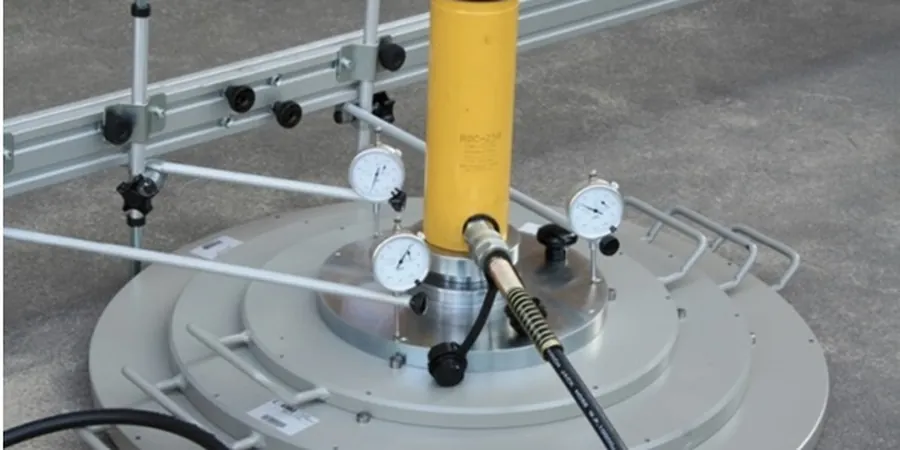
A plate load test in Hervey Bay's coastal sands provides the direct stiffness value that laboratory tests alone cannot guarantee — real ground, real load, real data.
Service characteristics in Hervey Bay
Critical ground factors in Hervey Bay
The sand deposits around Hervey Bay can be loose to medium dense near the surface, and the water table fluctuates with tidal cycles. A plate load test performed too shallow may overestimate settlement because the confining stress is low, while a test at the correct design depth captures the actual stiffness. If the test plate is not properly seated or the reaction beam flexes, the settlement readings become unreliable. We mitigate this by using a stiff reaction frame and multiple reference beams anchored at least 2 m from the test point. For layers with cemented bands, the test may show high stiffness locally, but the underlying loose sand governs long-term behaviour — we correlate PLT results with CPT data to avoid that trap.
Our services
We offer two variants of the plate load test tailored to Hervey Bay's ground conditions, plus a complementary analysis service.
Standard Plate Load Test (300 mm plate)
Suitable for verifying bearing capacity of shallow foundations on sand or stiff clay. Includes setup, incremental loading to 1.5 times design pressure, settlement monitoring, and a report with load-settlement curve and modulus of subgrade reaction.
Large Plate Load Test (600 mm plate)
Used for raft foundations or where the design footing width exceeds 1.5 m. The larger plate mobilises a deeper influence zone, providing a more representative stiffness value for the full foundation. Includes reaction beam design and verification.
Frequently asked questions
How much does a plate load test cost in Hervey Bay?
A standard plate load test (300 mm plate) in Hervey Bay typically costs between AU$1,490 and AU$1,750, including mobilisation, setup, loading, and a full report. The price can vary depending on site access, test depth, and the number of tests required.
What is the difference between a plate load test and a CPT?
A plate load test directly measures bearing capacity and settlement under a static load, simulating the actual footing. A CPT (cone penetration test) gives continuous profiles of tip resistance and friction, which are empirical correlations to stiffness. The PLT is site- and depth-specific; the CPT provides stratigraphic continuity. For Hervey Bay sands, we often use both: CPT for profiling and PLT for calibration of the design parameters.
How deep can a plate load test be performed?
Practically, plate load tests are limited to depths of about 3 to 4 metres because the reaction beam must be anchored or ballasted above the test level. For deeper tests, we use a reaction pile or a heavy excavator as the reaction mass. In Hervey Bay, the test depth is usually set at 1 to 2 metres, matching typical shallow foundation depths on sand.
Do I need a plate load test if I already have soil lab results?
Laboratory tests like triaxial or direct shear give strength parameters, but they cannot replace the direct load-settlement curve from a PLT. The plate load test provides the modulus of subgrade reaction (ks), which is essential for slab-on-grade and raft foundation design. For Hervey Bay's variable sand density, the PLT captures the real stiffness at the exact foundation level, reducing the risk of over- or under-design.