Hervey Bay sits on Quaternary coastal sands and estuarine deposits that can shift without warning. Many local projects underestimate how a thin clay lens or a perched water table alters embankment performance. A proper road embankment design must account for the region's variable groundwater, often only 1–2 metres below surface, and the loose sands that dominate the upper profile. Before placing any fill, we recommend a geotechnical site investigation to map soil layering and locate those problematic soft zones. Combining that with a plate load test gives direct modulus values for settlement control under the embankment core. For fills on compressible subgrades, preloading or vertical drains can accelerate consolidation and prevent long-term differential movement. This integrated approach reduces risk from day one.
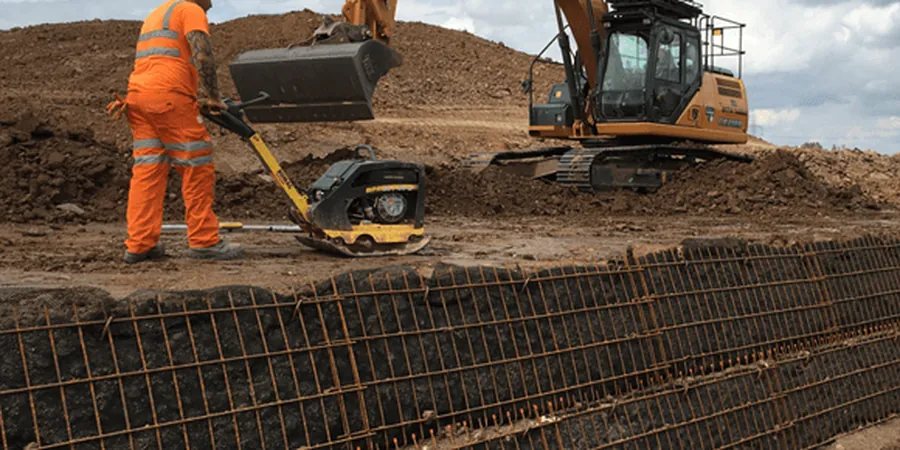
A one-metre rise in groundwater can reduce embankment factor of safety by up to 40% in Hervey Bay's coastal sands.
Service characteristics in Hervey Bay
Critical ground factors in Hervey Bay
A common mistake in Hervey Bay is assuming uniform sand conditions across a project site. The reality is that old creek channels and tidal flats create abrupt changes in bearing capacity and drainage. If a contractor places 4 m of fill on a hidden soft layer without adequate benching or drainage, the embankment can experience rotational failure within months. We have seen cases where shallow groundwater was not measured prior to construction, leading to pore pressure build-up that reduced effective stress below design limits. The solution is an early-stage investigation with piezometers and undisturbed sampling, plus staged construction with settlement monitoring. Cutting corners on that initial site model is the single biggest financial risk in local road embankment design.
Our services
Our road embankment design service covers every stage from site investigation to construction support. Below are the three core components we deliver for Hervey Bay projects.
Site Investigation & Material Characterisation
Boreholes, test pits, and laboratory testing (grading, Atterberg, Proctor, CBR) according to AS 1726. Includes groundwater monitoring and identification of soft layers that require treatment.
Slope Stability & Settlement Analysis
Limit-equilibrium slope stability (Bishop, Spencer) and 1D consolidation modelling. We provide factors of safety for short-term, long-term, and seismic conditions per AS 4678.
Construction QA/QC & Compaction Control
On-site density testing (sand cone, nuclear gauge), moisture control, and proof rolling. Reports include NATA-certified results and recommendations for lift thickness and roller passes.
Frequently asked questions
What is the typical cost range for a road embankment design study in Hervey Bay?
For a standard road project in Hervey Bay, the cost ranges between AU$1,800 and AU$7,290, depending on the number of boreholes, laboratory tests, and complexity of the slope stability analysis. A basic site assessment with two test pits and standard compaction testing falls at the lower end; a detailed design with consolidation testing and seismic analysis reaches the upper range.
How deep should boreholes be for a road embankment design?
Boreholes should extend at least 1.5 times the embankment height below the base of the fill, or into competent bearing strata, whichever is deeper. In Hervey Bay's sand deposits, that usually means 6–10 m depth for a 4 m high embankment.
What compaction standard applies to road embankments in Queensland?
The standard is AS 1289.5.1.1 (Standard Proctor) for fill materials. The specification typically requires 95% of maximum dry density (MDD) for general fill and 98% MDD for the upper 300 mm below pavement.
Can I build a road embankment directly on the natural sand in Hervey Bay?
Direct placement is possible only if the natural sand has adequate bearing capacity and is free of soft organic layers. Many Hervey Bay sites contain loose or saturated sands that require removal, replacement, or ground improvement before fill placement. A site investigation is essential.
What is the minimum factor of safety required for embankment slopes in Queensland?
AS 4678 recommends a minimum factor of safety of 1.5 for static conditions and 1.1 for seismic/rapid drawdown conditions. For critical infrastructure (e.g., arterial roads), many local councils require 1.6 static and 1.2 seismic.