On Hervey Bay's coastal strip, the ground often consists of loose sands and soft estuarine clays that struggle to support moderate to heavy loads. Many local developers have found that shallow foundations alone lead to excessive differential settlement within the first few years. Stone column design offers a proven ground improvement solution here: it densifies the surrounding soil while providing stiff, vertical drainage paths that accelerate consolidation. Before specifying a column pattern, the team typically reviews data from a resistivity survey to map the soil profile across the site, then combines that with load test results to finalise the spacing and column diameter.
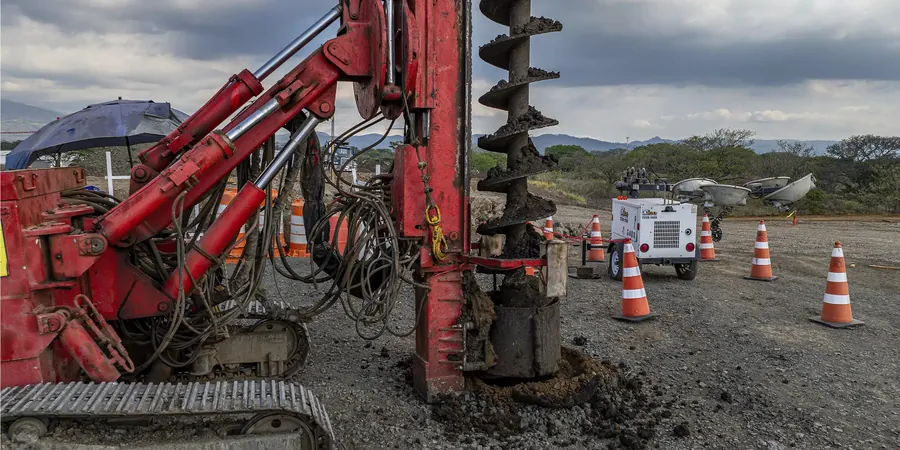
Bulging failure governs column capacity in soft estuarine clays below the water table, making column diameter and confining stress the critical design variables.
Service characteristics in Hervey Bay
- Column diameter and grid spacing – typically 0.9 m to 1.5 m diameter with 2.0 m to 3.5 m centre-to-centre spacing
- Replacement ratio – usually 15% to 35% depending on target bearing capacity
- Column length – designed to penetrate soft layers and terminate in a competent bearing stratum
- Material specification – well-graded crushed rock with less than 10% fines, compacted in lifts
Demonstration video
Critical ground factors in Hervey Bay
A common mistake made by contractors in Hervey Bay is assuming stone columns behave the same way in sand as they do in clay. In the saturated, low-permeability clays near the Urangan marina, a column grid that works for bearing improvement may fail to provide the drainage needed to prevent long-term creep. Without proper consolidation modelling, the design can underestimate post-construction settlement by 30% or more. The correct approach is to run a coupled consolidation analysis that accounts for radial drainage through the columns, using the coefficient of consolidation from oedometer tests on undisturbed samples taken during the site investigation.
Our services
Our stone column design service covers the full workflow from feasibility assessment through to construction verification.
Feasibility study and parameter selection
Review of existing borehole logs, CPTu data, and groundwater monitoring records to determine whether stone columns are the most cost-effective ground improvement method for the specific soil conditions in Hervey Bay. The study includes a preliminary column layout and settlement estimate.
Detailed design and production support
Preparation of column spacing, diameter, and length drawings with installation specifications. The design covers both bearing capacity and settlement criteria, and includes a trial column program with plate load testing to confirm the assumed parameters before full production.
Frequently asked questions
How much does stone column design cost in Hervey Bay?
The typical fee for a complete stone column design package in Hervey Bay ranges from AU$2,020 to AU$7,800, depending on the number of trial columns, the complexity of the soil profile, and whether a full 3D consolidation analysis is required.
What soil conditions in Hervey Bay are most suitable for stone columns?
Stone columns perform best in loose to medium-dense sands and soft to firm clays with undrained shear strengths between 15 kPa and 50 kPa. In Hervey Bay, the estuarine clays along the Pialba and Urangan foreshore are ideal candidates because they are saturated, compressible, and have sufficient confinement to mobilise the column bulging resistance.
How does stone column design address liquefaction risk in Hervey Bay?
In Hervey Bay's sandy layers, stone columns reduce liquefaction potential by densifying the surrounding soil during installation and by providing vertical drainage that dissipates excess pore pressure quickly during an earthquake. The design checks the post-improvement N-SPT value against the cyclic stress ratio calculated per AS/NZS 1170.4, and columns are spaced so that the improved zone covers the full footprint of the structure.