Many construction teams in Hervey Bay underestimate the effect of coastal sand layers on stormwater infiltration. They assume uniform drainage across a site. That assumption often fails. The sandy soils near the Great Sandy Strait can vary significantly in permeability within a few meters. Without an infiltration test, septic system designs fail and retention basins overflow. A double-ring infiltrometer measures the actual hydraulic conductivity at the surface. This data is essential for on-site wastewater management and permeable pavement design. Before finalizing drainage layouts, teams should combine the infiltration test with a permeability field test for deeper strata and a study of foundation soils to verify bearing conditions.
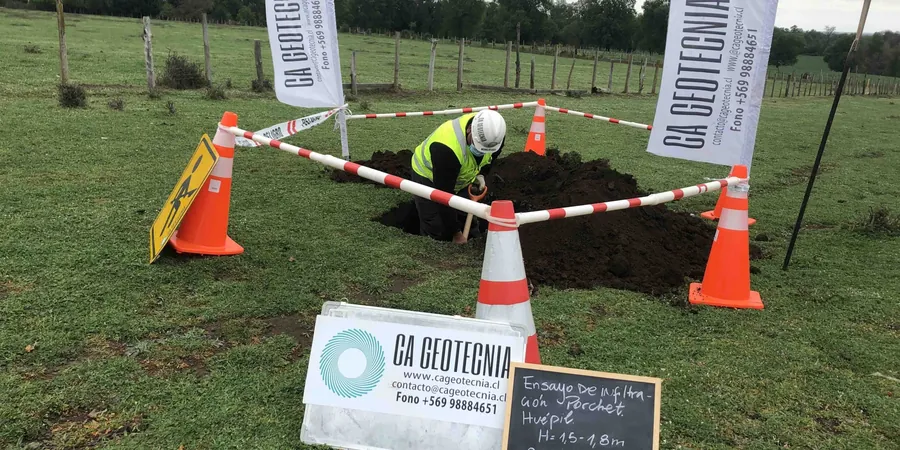
Sandy coastal soils can show a tenfold variation in infiltration rate over 10 meters. One test point is never enough.
Service characteristics in Hervey Bay
Demonstration video
Critical ground factors in Hervey Bay
In Hervey Bay, we often see developers skip infiltration testing on sites with shallow water tables near the Esplanade. The risk is direct. Without accurate Ksat values, stormwater systems are undersized. During heavy rain events, water ponds against structures. Foundations in the low-lying areas of Pialba and Urangan then experience rising pore pressures. The sandy soils can lose bearing capacity quickly. We have documented cases where retaining walls failed because the drainage layer was designed for permeability values that were ten times higher than reality. A single infiltration test at the wrong spot gives a false sense of security. Multiple tests across the site are mandatory.
Our services
We offer two standardized field infiltration services tailored to Hervey Bay's coastal conditions.
Double-Ring Infiltrometer Test (Constant Head)
Full constant-head test with dual-ring setup. Includes Mariotte bottle regulation, 2-hour steady-state monitoring, and calculation of Ksat. Report includes infiltration curve and design recommendation for drainage systems.
Porchet (Falling-Head) Infiltration Test
Single-ring falling-head method for rapid assessment. Suitable for preliminary drainage design and septic tank siting. Three test locations per site. Results expressed in mm/h with soil classification.
Frequently asked questions
How many infiltration test locations are needed for a standard residential block in Hervey Bay?
For a typical 600 m2 residential lot in Hervey Bay, we recommend a minimum of three test locations. One near the proposed septic area, one in the backyard drainage zone, and one near the street frontage. Coastal sands with shell fragments can show high variability across short distances.
What is the difference between the double-ring and Porchet (single-ring) methods?
The double-ring method uses an outer buffer ring to prevent lateral water flow. This gives more accurate Ksat values for design. The Porchet method is a single-ring falling-head test that is faster but less precise. For Hervey Bay projects requiring council approval for stormwater management, the double-ring test is the preferred standard.
How does the high water table in coastal Hervey Bay affect infiltration test results?
A shallow water table saturates the soil profile and reduces the effective head difference. This can produce artificially low infiltration rates if the test is conducted when the water table is within 1 meter of the surface. We recommend testing during the dry season or using a piezometer to record the water table depth during the test. The results must be interpreted with the groundwater level clearly noted.
What is the typical cost range for an infiltration test in Hervey Bay?
The cost for a full double-ring infiltrometer test with three locations and a technical report typically ranges between AU$460 and AU$650. The Porchet single-ring test is on the lower end of that range. Prices vary with site access and number of test points.
Can an infiltration test be done on clay soils common in the western suburbs of Hervey Bay?
Yes, but the test duration increases significantly. Clay soils in areas like Kawungan and Eli Waters have low hydraulic conductivity. The double-ring test may need to run for 4 to 6 hours to reach steady-state conditions. The falling-head method is less suitable for clays because the water level drops too slowly. We use the constant-head method with extended monitoring for these soil types.