Hervey Bay grew fast from a fishing village into a major coastal hub. The city sits on Quaternary sand deposits overlying weathered basalt and sedimentary rock. Many subdivisions went in without thorough subsurface knowledge. That creates problems today. Electrical resistivity surveys give us a clear picture of what lies beneath without drilling everywhere. We use Vertical Electrical Sounding (VES) to map layer thickness and detect groundwater. Before any deep excavation or foundation design, we recommend pairing resistivity data with a geotechnical site investigation to confirm soil properties. The method works especially well in Hervey Bay's sandy coastal soils where traditional drilling can miss hidden clay lenses.
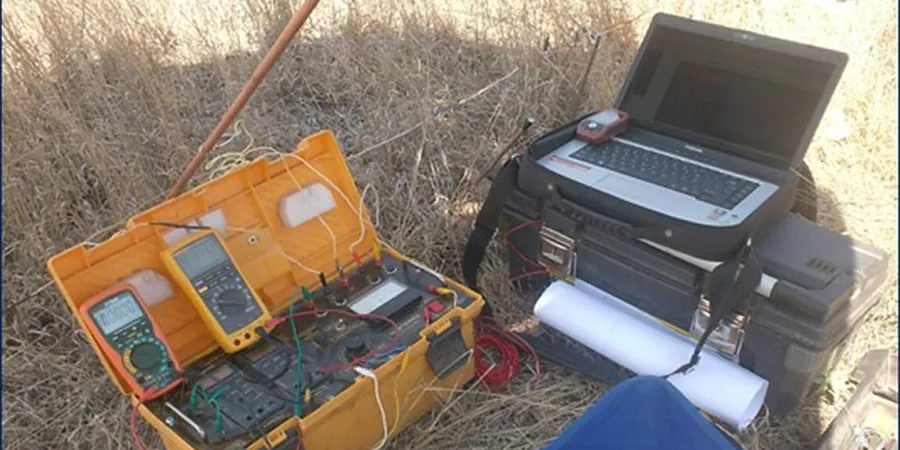
VES surveys map groundwater and soil layers down to 100 metres without a single borehole — ideal for Hervey Bay's coastal sands.
Service characteristics in Hervey Bay
Critical ground factors in Hervey Bay
A common mistake we see in Hervey Bay is builders relying on a single borehole for a whole block. Coastal sands can hide abrupt changes in groundwater salinity and clay content. One test hole might miss a buried channel filled with soft silt. Without resistivity profiling, you cannot see lateral variability. That leads to differential settlement or slab heave. We had a project on Esplanade where the client skipped geophysics and poured a raft slab. Six months later the slab cracked along a buried creek line. A simple VES line would have caught it. Don't guess what the ground is doing between boreholes. Resistivity fills that gap.
Our services
We tailor electrical resistivity services to Hervey Bay's coastal and urban conditions. Each service uses the same high-resolution equipment but adapts the array and depth to your project's needs.
Vertical Electrical Sounding (VES)
1D soundings for depth-to-bedrock, groundwater table, and saltwater interface. Ideal for bore siting and foundation depth decisions in residential subdivisions.
2D Electrical Resistivity Tomography (ERT)
Continuous 2D profile along a transect. Maps lateral changes in soil type and moisture. Used for pipeline routes, road corridors, and landfill site assessments.
Time-Lapse Resistivity Monitoring
Repeated surveys over months or years to track groundwater movement, leachate plumes, or dewatering effects. Applied at landfills and construction dewatering sites in Hervey Bay.
Frequently asked questions
How deep can VES surveys reach in Hervey Bay soils?
With a 100 m electrode spread we typically reach 40–80 m depth in the sandy coastal soils around Hervey Bay. In areas with conductive saltwater intrusion the signal attenuates faster, limiting depth to around 50 m. We adjust electrode spacing on site to match target depth.
Do I need resistivity if I already have boreholes?
Boreholes give you point data every few metres. Resistivity gives you continuous profiles between those points. In Hervey Bay's heterogeneous coastal sands, a single borehole can miss a buried sand-clay boundary. Resistivity fills those gaps and reduces the chance of unexpected ground conditions during construction.
What is the typical cost range for a VES survey in this area?
For a standard VES survey with 48 electrodes and 2D inversion, costs range from AU$950 to AU$1,470 depending on site access and line length. Multi-line projects or time-lapse monitoring will be quoted separately. We provide a fixed price after a site walkover.